
3 Things with Katherine Juengel
Portland has an amazing sustainability community, and we want to highlight the people and work that shape our unique city. We’re sharing their answers to questions we posed.
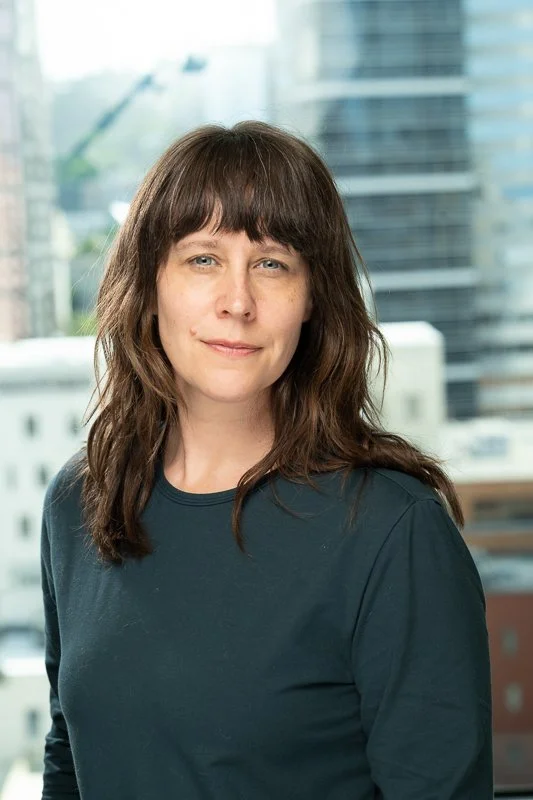
Meet Katherine Juengel. Katherine is the Green Cities Industry Liaison at Prosper Portland, the economic and urban development agency for the City of Portland. She has worked at Prosper Portland for more than 15 years in various roles ranging from project managing Central City redevelopment projects to local entrepreneurship programs. She holds a Masters in Urban and Regional Planning from PSU and a bachelors degree in Physics from the University of Illinois at Urbana-Champaign. in 2021, Katherine began her current role as the agency’s Green Cities Industry Liaison. In this role, she functions as a resource connector and point person for companies and industry initiatives in clean tech, environmental technologies, and green building. In her day-to-day work, she connects regularly with Portland Green Cities companies to support their growth with resources and introductions, collaborates on projects and initiatives such as Powerize NW and the Oregon Mass Timber Coalition, manages a local industry website called webuildcities.com, and partners with many different organizations and stakeholders to support a thriving and inclusive Green Cities landscape in Portland.
Now, we’ll hand it over to Katherine to share their perspective on sustainability, Portland’s future, and the projects and collaborations that inspire them.
1. What does sustainability mean to you?
I go back to the three pillars of sustainability - balancing social, environmental, and economic sustainability. In my work, I like to find ways for these pillars to support and reinforce each other rather than standing alone. While no one project can balance these three considerations perfectly, but as a community, we should be cognizant of where we may be out of balance when we look at the sum of our efforts community-wide, especially as we look at how the local and state economy is performing compared to the rest of the country.
That said, I’m very passionate about seeing where policy can incentivize new markets in a way that can tie to national or international demand signals, create economic opportunity and lead to quality jobs and entrepreneurship opportunities for our community. Economic sustainability needs to lead with intentionally growing jobs at companies that serve a national or international market (traded-sector jobs) because that makes our economy resilient and more sustainable over time. Having a diversity of traded-sector companies is important because they have a multiplying effect on our economy, providing jobs, bringing investment to our community, and supporting local service businesses.
2. Name a Portland (or Oregon) project or collaboration that has inspired you, and tell us why.
The recently announced expansion of OpConnect into a new facility in the Central Eastside reflects how Prosper Portland can support clean technology company growth locally with supportive policy, procurement and support from ecosystem partners.
OpConnect is a turnkey EV infrastructure provider for fleets and multifamiliy properties. They have developed their own customizable software and assemble chargers right here in Portland. The City of Portland chose OpConnect as their vendor for managing their charging infrastructure for their fleet decarbonization efforts several years ago and that, combined with similar contracts with other local partners, supported their growth to be competitive nationally. Along their journey of over a decade, we were there connecting them to resources like investors, trade show opportunities, local innovation partners, workforce support grants and finally a $2 million loan to support upfront costs to deliver on the largest contract they had won to date in California. OpConnect is also a local innovation story. They continue to iterate, improve and expand their offerings for both hardware and software, with a designated R&D space at their new building. Currently I am helping them to identify funding to pilot a new new solar canopy technology from another local startup to build parking lot solar and potentially build capabilities for a small microgrid. Supporting an early-stage company from technology commercialization to growth is something that inspires me, especially with such a mission focused, community minded and innovation forward team such as OpConnect.
3. What can Portland (or Oregon) be doing better to be more sustainable?
I think there’s a lot of untapped opportunity in our industrial lands here in Portland and we need to have a holistic community vision for a green manufacturing sector. We have amazing assets that we aren’t fully utilizing: the state’s largest industrial district, a maritime infrastructure at the confluence of two rivers, and intermodal logistics and transportation that tie it all together. We know manufacturing jobs, particularly in clean technology sectors, are quality jobs that have good promotion pathways where you don’t need a college degree and generally earn wages above service sector wages. And we really need these jobs right now.
We also have so many assets in terms of companies and talents on the industry side: in addition to our green building expertise, we have wood product innovation including mass timber, a set of emerging companies in modular and panelized off-site construction, a range of companies in the energy sector anchored by not one but two utilities plus BPA, a public and private sector dedicated to multimodal transportation decarbonization, not to mention an electronics and semiconductor industry just right next door. Many cities would love to have this diversity of industry expertise, drive and talent and we can do so much more to build on our natural community strengths in these areas. That said, our industrial land needs investment and we lack large enough sites or modern facilities to attract the types of clean tech manufacturing jobs we would like. I encourage folks to follow the conversations about industrial lands happening at the local, regional and state level and explore with others in the sustainability community about how we could grow a green manufacturing sector here, what that would look like and what we need to do to make that happen.